
Yiwu Market seems like a buyer's paradise—endless aisles of products at incredibly low prices.1 But when you need consistent quality and brand-specific designs, you start to worry if it's too good to be true.
For small, ready-made, generic orders, Yiwu can be faster. But for any brand needing customization, guaranteed quality, compliance, and large volumes, sourcing directly from a factory is the only professional and ultimately more cost-effective choice. It eliminates risk and middleman markups.
I've been manufacturing photo albums for over ten years, and I've met many clients who came to me after trying to source from Yiwu. They were lured in by the low initial prices but quickly ran into problems with quality, consistency, and communication. The key thing to understand is that Yiwu and a dedicated factory serve two completely different purposes. Let's break down exactly what that means for your business.
What Are You Really Buying at Yiwu Market?
You find a beautiful album at a Yiwu stall for an unbeatable price. But when you try to reorder three months later, the color is slightly different, the paper feels thinner, and the original stall owner doesn't remember you.
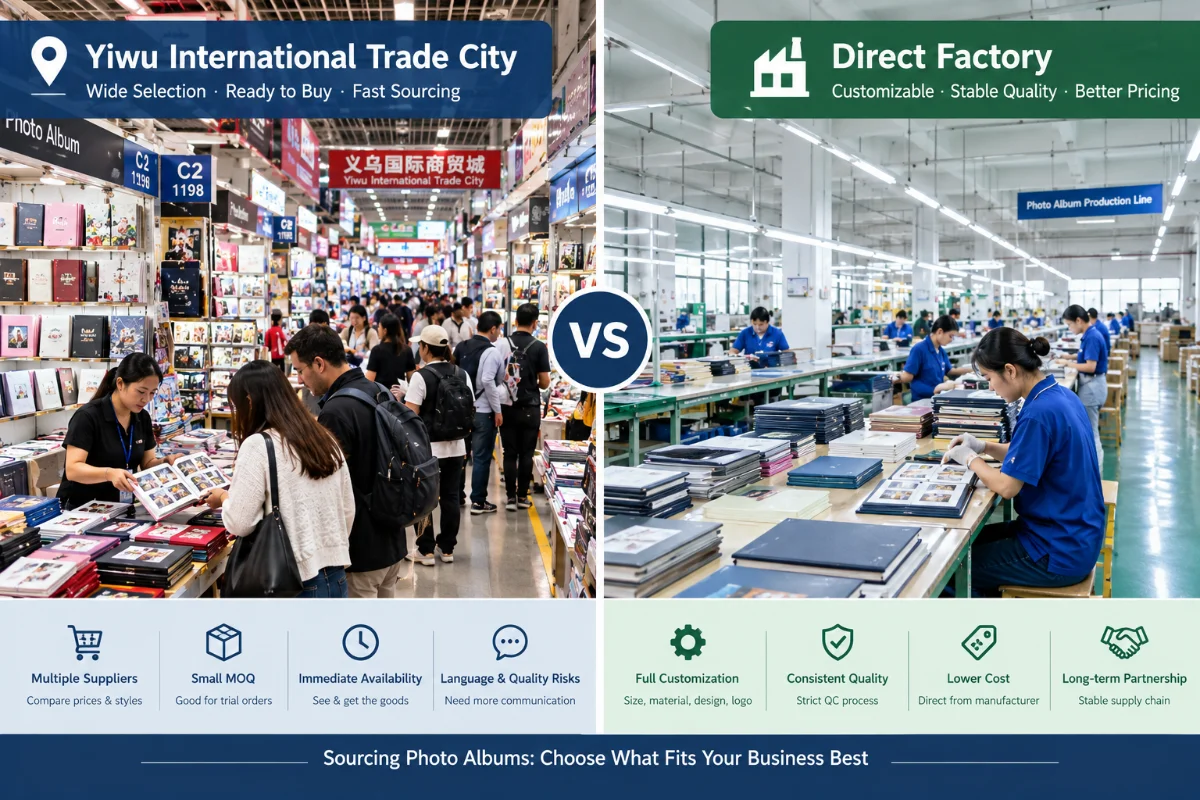
At Yiwu, you're typically buying from a trader, not the actual manufacturer. You get access to ready-made stock from various small workshops. This offers variety and low MOQs but sacrifices consistency, quality control, customization, and any direct line to the people making your product.
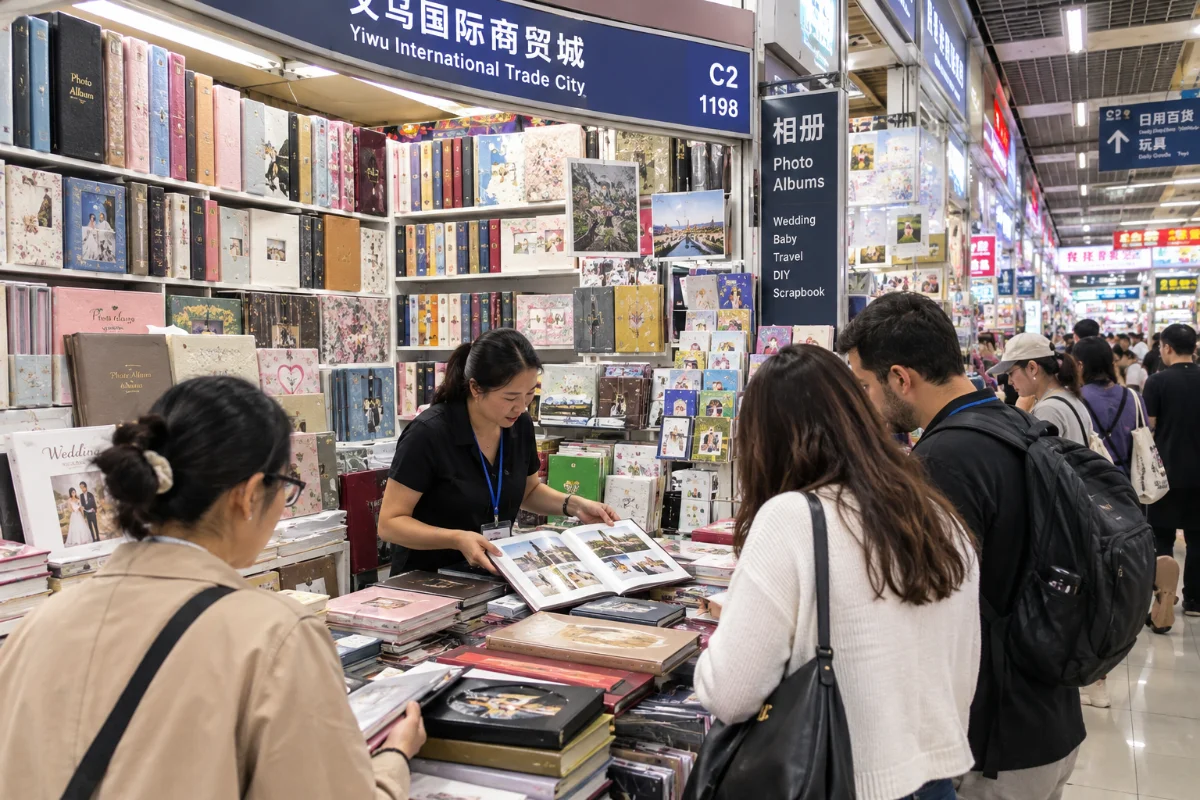
Think of Yiwu as a giant showroom. The people in the booths are salespeople representing multiple small, often family-run workshops. They don't own the production lines. This model is great if you want to buy 200 of this album, 150 of that one, and ship them all together. But the hidden cost is inconsistency. The trader might source from Workshop A one month and Workshop B the next, depending on who is cheapest. You, the buyer, have no control over this. I once had a client, a purchasing manager for a European gift store chain, tell me about his Yiwu nightmare. He ordered 1,000 albums, and they were perfect. His reorder of 1,000 was a disaster—the linen cover was a different dye lot and the pages were misaligned. The trader just shrugged. That's when he came to us, a dedicated factory, because he needed reliability.
| Aspect | Yiwu Market | Direct Factory |
|---|---|---|
| Your Contact | Trader / Middleman | Sales Manager / Engineer |
| Product Source | Multiple unknown workshops | A single, audited factory |
| Consistency | Low; quality can vary batch to batch | High; standardized process |
| Ideal For | Small, mixed, ready-made orders | Large, customized, brand-specific orders |
Can You Get True Customization and Brand Protection from a Trader?
You have a very specific brand identity. You need an album in your exact Pantone color, with a custom debossed logo, and a unique type of recycled paper. The Yiwu trader says "no problem," but the samples are all wrong.
No. True customization requires direct collaboration with factory engineers and production managers.2 A trader is a middleman who can't oversee complex technical details. A factory partner works with you to create tooling, match colors, and source specific materials for your brand.

When a brand owner comes to ELIO Stationery with a custom request, it's the beginning of a conversation. We discuss technical drawings. We create a new mold for their unique debossed logo. My team mixes ink to get a perfect Pantone match for their cover material. We source specific FSC-certified paper to meet their brand's sustainability promise. This is a deep, collaborative process. A trader in Yiwu simply relays messages back and forth, and crucial details get lost in translation. They don't have the technical expertise to advise on what's possible. Even worse, if you give your unique design to a trader, you don't know which workshops will see it. There's a real risk your design could be copied and sold to your competitors from another stall. Working directly with a vetted factory protects your intellectual property and ensures your brand vision is executed perfectly.
What About Compliance for Large-Scale Orders?
You've landed a huge order with a major US retailer for 50,000 albums. They're demanding a recent BSCI audit report and proof of REACH compliance for all materials. Your Yiwu contact has gone silent.
Yiwu is not structured for large, compliant orders required by major retailers. A professional factory is audited for social compliance (BSCI) and environmental standards (FSC), and ensures all materials meet international chemical safety standards like REACH and SGS.

This is the most critical difference for any serious importer, wholesaler, or brand. Major retailers in the US and Europe will not risk their reputation on non-compliant products. They need proof that your products are made ethically and safely. My factory undergoes regular, rigorous audits for BSCI (Business Social Compliance Initiative), which proves we treat our workers fairly. Our FSC (Forest Stewardship Council) certification guarantees our paper comes from sustainable sources. We test our materials to ensure they are REACH compliant for the EU market. These certifications are expensive and time-consuming to maintain. The small, anonymous workshops that supply Yiwu traders simply do not have them. Trying to save a few cents per album in Yiwu can cost you a multi-million dollar contract. A direct factory partner provides you with a full "compliance package" that gives you and your retail partners complete peace of mind.
Conclusion
Yiwu has its place for small-scale sourcing of generic goods. But for a professional brand that values quality, consistency, customization, and compliance, a direct partnership with a dedicated factory is the only path to long-term success.
References
"Yiwu International Trade City - Wikipedia", https://en.wikipedia.org/wiki/Yiwu_International_Trade_City. This source provides an overview of Yiwu Market's scale and its reputation as a hub for low-cost goods. Evidence role: general_support; source type: encyclopedia. Supports: Yiwu Market is known for its vast selection of products and competitive pricing.. ↩
"Product Design at Carnegie Mellon University", https://www.design.cmu.edu/about-our-programs/undergraduate-degrees/products. This source outlines the process of customization in manufacturing, emphasizing the role of direct factory collaboration. Evidence role: mechanism; source type: education. Supports: Customization in manufacturing is best achieved through direct collaboration with factory engineers and managers.. ↩